
Iran Week Two
New Forever War Boogaloo?

Welcome to a second weekly update on the Iran war. I hope it’s the last. But while a growing storm of pressures may well push the president to cry uncle in the coming weeks, unwinding this conflict in practice may prove more challenging than a simple decision to end it.
I’m increasingly seeing usage of the term “Third Gulf War” by commentators, and without a doubt this now ranks among the biggest conflicts in the region’s recent history. But it may not be as discrete an event as some assume. The dynamics of the conflict, energy markets, and conflict all suggest that it might rumble on for quite some time. It is certainly the case that some long-term ramifications can no longer be avoided.
Short Term Pain, Long Term Gain?
As anticipated, the disruption to markets has only grown with the length of the conflict.
The White House, which has been peculiarly unprepared for the long-expected outcome of any significant conflict in the Gulf, appears to have settled on a message that this will produce “short-term pain for long-term gain.” Administration spokespeople are effectively arguing that disruptions in the market will be temporary — dare I say transitory? — and that there will be no long-term impacts from the war other than the benefits of whatever strategic goal it is intended to achieve.
The president’s messaging on Monday afternoon, that the war was “nearly complete,” helped to soothe panicking markets: the price of Brent Crude immediately dropped 11 percent from a high close of $120. The president, however, has since that time issued statements calling for Iran’s unconditional surrender, and suggesting a longer conflict. The administration is considering some mitigating strategies, including escort convoys in the Strait of Hormuz or the release of strategic petroleum reserves, but thus far has done little practical. If they do not do so in the next couple of days, prices will again push higher.
But let’s assume for the sake of argument that this war does end within the week.1 The “short term pain, long term gain” narrative is still pretty questionable. The stakes are certainly high enough that regional states will be very keen to get energy moving through the Strait of Hormuz as fast as possible. Oil prices should drop fairly quickly. But there are significant caveats to the idea that long-term pain can be limited. First, it will take time to restart production, perhaps days or even weeks to do so. Refineries need to be restarted, facilities reopened or repaired, and shipments need time to get to consumers. The ramifications of earlier generations of energy crisis (the 1973 oil embargo, for example), were felt for years in stagnation, inflation, and political fallout.
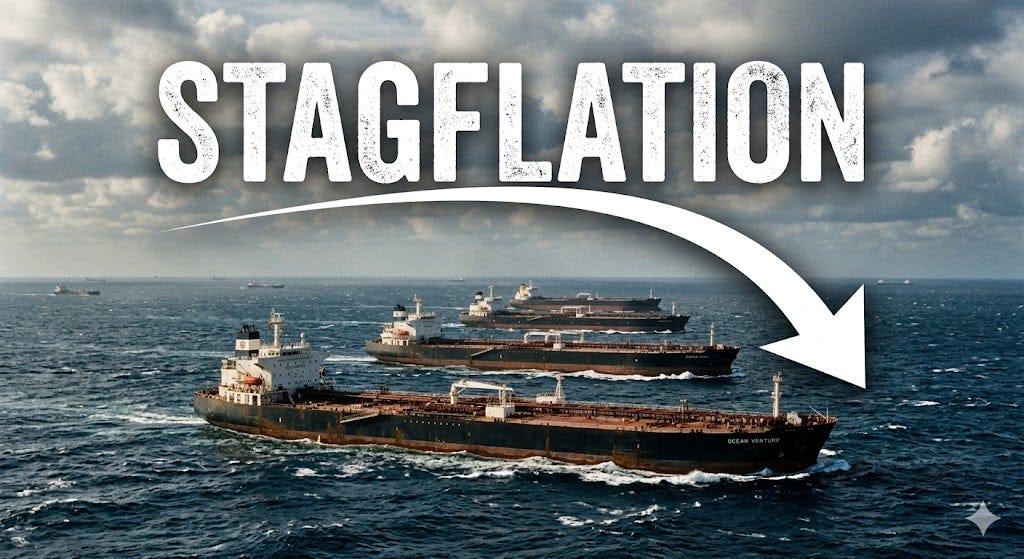
Second, we haven’t yet seen any significant destruction of energy infrastructure. But refineries in the UAE and Oman have now been targeted, and there have been attempted attacks on Saudi oil fields and Qatari gas export facilities. If such attacks become more successful and widespread, the long-term ramifications will be worse. The same goes for destabilization within Iran itself or the widening of the war.
For both reasons, long-term estimates (i.e., oil futures) are suggesting prices somewhere close to $85 for the remaining year. It’s a reasonable price, but as much as $30 more than late last year. With midterms coming in November, the administration may find itself hard pressed to sell voters on even this moderate amount of long-term pain if they also can’t point to some genuine gain.
Closing Time For Real
Like many folks in DC, I teach a course as an adjunct professor once or twice a year, including a course on Oil and International Security, which provides a nice respite from US foreign policy work while allowing me to keep my background in eneup to date. But it’s also been a hell of a ride. In the last four years, I’ve had to rewrite parts of the course multiple times due to a significant energy-related crisis.
In 2022, Russia invaded Ukraine, kicking off a multi-month period of intense reshuffling in global energy flows as European states initiated sanctions and attempted to shift away from Russian gas. In September of that year, the Nordstream pipeline was mysteriously blown up, leaving the class to explore the contentious pipeline politics of Eastern Europe — and trying to figure out which party had the motive and opportunity to do it. Last year, the Houthis were engaged in an active bombing campaign in the Red Sea, forcing tankers to divert preexisting routes, and leading to a short, largely unsuccessful US military campaign to protect maritime shipping. Now, we have a worst-case scenario in the Gulf.
It’s been a fun few years.

But it’s also worth noting that each of these incidents — as in the current moment — enabled us to update our understanding of the specific risks from energy disruptions. Energy markets have changed a lot since the disruptions of the 1970s and 1980s, on which most of the existing research is based; more recent incidents have forced us to update our priors on how conflict might shape global markets.
Amy Myers Jaffe has a good piece on the way in which oil shocks look different today domestically. I’ll add a few thoughts here on the security studies literature, which thus far has actually been remarkably accurate in its predictions.
Two specific articles are worth mentioning, as they bear directly on the current scenario: Caitlin Talmadge’s “Closing Time,” and Eugene Gholz and Daryl Press’s “Protecting the Prize.” Both articles are relatively skeptical of the notion that significant risks exist to the free flow of oil from the Gulf — but each explicitly calls out the Hormuz scenario as one of the riskier cases. Neither provides much ground for optimism in the short term.
Gholz and Press explore a variety of oil shocks (i.e., the 1973 oil embargo, Iranian Revolution, and Gulf War) and conclude that markets are extremely self-regulating. Because oil is priced and shipped globally, even significant disruptions produce market adaptation and prices eventually return to normal. This argument is entirely accurate, and indeed, we also saw it in operation during the last major energy shock of the 2022 invasion of Ukraine. The caveat to it, however, is that most disruptions are resolved within 3 to 6 months and — as we saw in 2022, there can be significant impacts to markets and consumers during that interim period.
Gholz and Press also argue that it is effectively impossible for Iran to close the Strait of Hormuz in practice — anti-missiles are too ineffective against thick-hulled tankers, mines too unreliable, etc. This matches Talmadge’s argument that the shipping can be harassed or hindered in trying to navigate the strait, but long-term blockage would be effectively impossible in the face of concerted US or international military action to clear it.
We’re now getting a case study in how all of this plays out in practice. The Strait of Hormuz is not “closed” in a technical sense; it is, however, effectively off limits to traffic. Political scientists were largely correct in their assessment that the Strait would not be closed by, ie, large-scale mining operations, but rather by harassment of vessels and fear of strikes. As the price of oil rises over time, some companies and crews will inevitably find it worth the risk to try to make the crossing, and the United States will find it increasingly necessary to use military means to reopen the passage.
That doesn’t mean, however, that it would be easy. As Talmadge puts it, “the notion that Iran could truly blockade the strait is wrong—but so too is the notion that U.S. operations in response to any Iranian action in the area would be short and simple.” De-mining, escort missions, and other relevant activities would all bring U.S. forces in closer range of Iranian attacks, increasing the risk of casualties, and such a campaign could be lengthy and repetitive.
More generally, it has been an astounding four or five years in terms of geopolitical instability for energy markets. There’s going to be some great studies written about this era, but one factor I think is currently underplayed is how much the United States, which was always assumed in such studies to be the firefighter for crisis in the Gulf, has instead become the arsonist. Through the crises of the 1970s, 80s, and 1990s, the United States was the one attempting to prevent regional actors from undermining energy flows. Today, the Strait of Hormuz is closed not because of unilateral Iranian actions, but because of America’s choice to start a war.
As I wrote in today’s Financial Times, the face that the United States is now an agent of chaos for global energy markets may have long-term implications for how other countries like China build their own energy security strategies.
Endgame
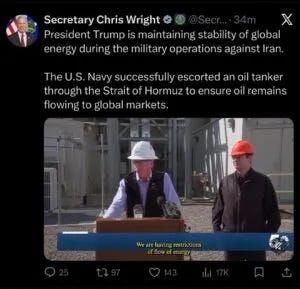
The stock market is behaving like a yo-yo. Prices rise on reports of conflict and the continued effective closure of the Strait of Hormuz; they fall on indications that the conflict may end soon. Contradictory and sometimes inaccurate messaging from the administration is only adding to this chaos. A mistaken tweet from the Secretary of Energy on Tuesday, for example, touted American success in escorting a tanker through the Strait successfully. This apparently never happened; the tweet was deleted shortly thereafter, and markets boomeranged.
But let us say for the sake of example that the administration is in fact serious about wrapping this war up expeditiously. It’s widely known that the president in particular tends to back off when confronted with significant opposition. This fact seems to be moderating markets and comforting the American public. Nonetheless, as various observers have noted, the choice to end this conflict may not lie entirely with the White House.
Iran has faced widespread bombing, the killing of its supreme leader, and a series of deadly and damaging strikes to both infrastructure and civilian targets. The new Supreme Leader lost his wife, father, mother, and child in airstrikes. For the Iranian regime to agree to end this conflict, they would have to believe that it is not going to restart again soon. And after last June’s strikes and this new war, that will be a very hard sell. It certainly does not suggest an Iran that is significantly more willing to make concessions than previously.
In short, the United States can declare victory, but even if the US were to remove most of its troops from the region, we cannot remove US allies in the Gulf, nor continue to protect shipping without those troops. If Iran chooses to continue a long-term harassment strategy in the hopes of raising the political and economic costs on the United States, then the Trump administration will face a costly choice: escalate or offer concessions.
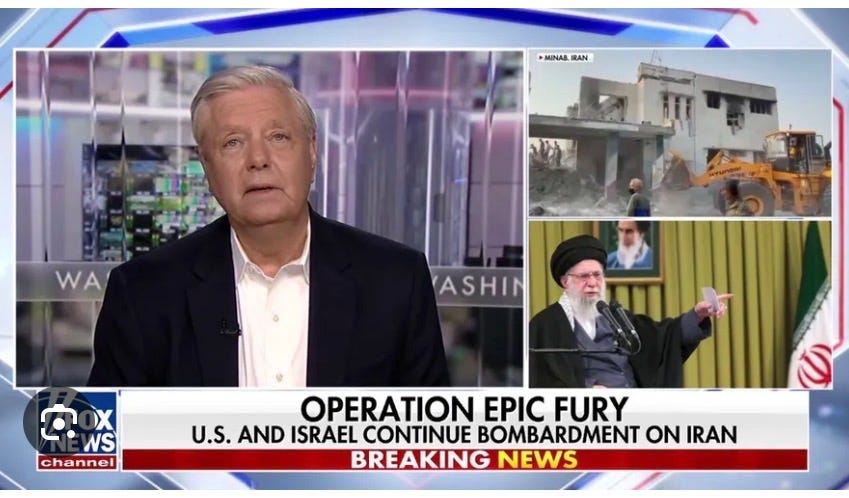
Thus far, the central conclusion I am drawing from this war is the utter failure of the hawkish “maximum pressure” strategy against Iran. Sure, it may look as if Lindsey Graham is getting his heart’s desire. Yet every day that this war continues undermines his arguments that Iran will simply cave once enough pressure has been applied. That we have made it to the military option at all is an indictment of years of prior sanctions and military strikes.
And though it is too early to tell what the long-term results of this conflict will be, it frankly seems more likely that Iran will sprint for a nuclear weapon than give up their enrichment capabilities. The reason Iran hawks gave back in the late 2010s for killing the Obama-era nuclear deal was that it offered a potential long-term path for an Iranian nuclear weapon if things went poorly. It is their advice — pulling out of the deal and doubling down on pressure — that has brought us to this end instead.
I don’t think this likely, but you never know.
Most emphathic agreement for your conclusion. When it comes to Iran, US under the two Trump administrations has burned its trustworthiness to ashes. US supplying and defending the appalling Israeli genocide of Gaza not helpful either. How do you trust leadership doing that?
Zero-trust solutions are nevertheless possible, and regional balance thru the classic "MAD" equilibrium between Israel and Iran is the most obvious possibility. One could imagine solutions involving China or Russia promising some form of guarantees, but they themselves have been antagonized repeatedly in recent years by the US and are less than enthusiastic about putting out a fire for which Trump will take the blame.
Peace thru Iran developing a nuclear weapon - should the younger Khamenei reverse his own father's fatwa against such weapons - also suffers from a entirely unknown timeline. Oil markets won't wait. Regarding the sources cited above, modern tech makes it easier for a belligerent entrenched on shore to control a 50+ mile strip of sea lane. It's not for nothing that Russia, China, and the US, and Ukraine have all copied the Shahed 136 drone. This is the Kalashnikov of our time. These weapons are more precise, more selective, and an order of magnitude more cost-effective compared to the missiles and mines with which Iran and Iraq fought their tanker war 40 years ago.
Also oil tankers, while tremendously robust, do burn terribly and two or three hits from these cheap pickup-truck-mounted weapons will total a tanker. The situation is compounded by the fact that the Iranian side of the Gulf enjoys the cover of terrain much better than the other side where the US bases are, or what's left of them.
It very much seems that Iran can selectively control whose ships pass. The oil market is using coordinated release of reserves to stabilize the situation. Okay for now, but something like high mid-high single digit number of weeks, and there will be real panic.
"But let us say for the sake of example that the administration is in fact serious about wrapping this war up expeditiously. " - This assumes that the U.S is in the driver's seat. Its not.
There was a possibility for this to end well for the u.s, and that period has gone. It started when Trump pulled out of the Iran deal Obama set up in order to tamp down whatever incriminating evidence Israel has on him. then Kushner and the mobster's pushed him into believing Iran would start a war with America, possible assasinate Trump himself. Its Kabuki theatre.
the writer here should spend some time in the shadows, or alternatively with the Analysts from the region who actually know what is happening.